Learning Outcomes:
i. Explain the concept of Karnaugh Maps (K-Maps) and their purpose in simplifying Boolean expressions.
ii. Understand the structure and elements of a K-Map for logical expressions with two and three variables.
iii. Analyze and apply K-Map techniques to simplify Boolean functions visually and systematically.
iv. Recognize the benefits of using K-Maps for optimizing digital circuits.
Introduction:
Remember those logic circuits we built with gates in the previous lesson? Sometimes, those circuits can get a bit tangled and complex. That's where K-Maps come in, like friendly puzzle masters helping us simplify things and build more efficient circuits!
i. The K-Map Playground:
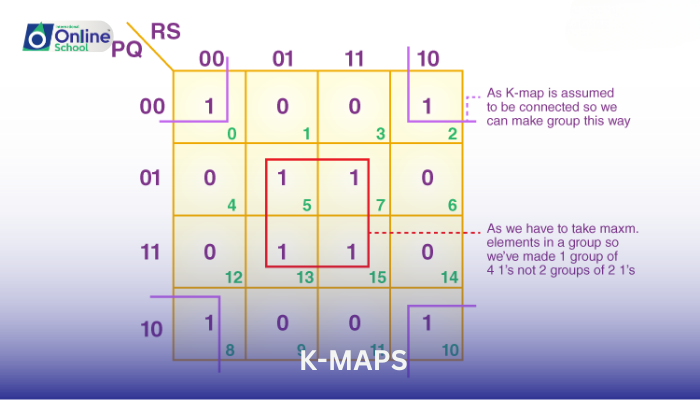
Imagine a grid with boxes, each representing a possible combination of our "on" and "off" logic states (usually 0s and 1s). For two variables, we have a 2x2 grid, like a tiny checkerboard. Each box gets a number based on the binary values of its row and column. Then, we mark the boxes corresponding to the "on" terms in our Boolean expression.
ii. Grouping for Efficiency:
The K-Map magic lies in finding clever ways to group these "on" boxes. We can combine adjacent boxes (horizontally, vertically, or in squares) as long as they follow the rules of our logic gates. These groupings represent simplified terms in our expression, making it shorter and easier to understand.
iii. Three Variables Join the Party:
K-Maps can handle not just two, but even three variables! The grid gets a bit bigger, but the principle remains the same. We identify "on" terms, find clever groupings, and watch our expression shrink as we replace those groupings with simpler terms.
iv. Benefits of Simplifying with K-Maps:
Using K-Maps has several advantages:
Reduced complexity: Simpler expressions mean less circuitry, saving space and resources.
Improved performance: Optimized circuits work faster and consume less power.
Easier troubleshooting: Clearer expressions are easier to debug and maintain.
K-Maps are powerful tools for simplifying logic and building efficient circuits. By understanding their structure and techniques, you become a puzzle master of the digital world, able to translate complex expressions into elegant and practical designs. Remember, mastering K-Maps unlocks your potential to build better, faster, and more efficient digital creations!
